
Monitoring Data in the EU: Why the Location of Your Polling Nodes Matters


When choosing a monitoring tool, almost everyone looks at check intervals, alert channels, and price. One question usually stays invisible, until your client's data protection officer asks it: where exactly are these checks actually run? The location of your polling nodes isn't a technical footnote: it's the core of your GDPR case. Because every check processes data, and whether that happens inside or outside the EU decides whether your data-protection statement is a single sentence or a long chapter. This article explains, factually, why the location matters.
Every check is a data-processing operation
The first step is a shift in perspective: monitoring feels like passive observation, but it's active data processing. Every single check generates and processes information: the URL checked, the timestamp, the location of the checking node, the HTTP status, the response time, sometimes parts of the response itself. That data is transmitted, evaluated, and stored. In data-protection terms, monitoring isn't a special case; it's processing like any other.
And wherever processing happens, the question of location arises. The GDPR ties central obligations to whether personal or attributable data leaves the European legal area. A monitoring check run from a node in Virginia is processing on US soil, regardless of where your client, their website, or you happen to sit. That's exactly where the difference most tools stay quiet about begins.
EU hosting is not the same as EU polling
Here's the most commonly overlooked detail, and the point where many providers turn vague. "Hosted in the EU" sounds reassuring, but it answers only half the question. There are two separate locations, and both count:
The hosting location is where the platform and its database sit, where your monitoring data is stored and converges. The polling location is where the checks are actually launched from, the geographic position of the checking nodes that query your client sites.
Those two can diverge. A tool can run its database in Ireland and thus market itself as "EU-hosted", while still running the actual checks from a global mesh of nodes spread across the US, Asia, and South America. In that case the processing, the check itself, originates outside the EU, and the data only travels to Europe afterward, for storage. The third-country transfer has long since happened. For a clean GDPR case, both locations therefore have to be in the EU, not just the one that's more convenient to name.
Why this drastically shortens the GDPR case
The practical value of end-to-end EU monitoring shows up the moment your client, or their data protection officer, starts asking questions. The most laborious part of any data-protection assessment is the third-country transfer: processing personal data outside the EU. Once data leaves the EU, the argument gets long: you need a legal basis for the transfer, usually standard contractual clauses, plus a transfer impact assessment that examines whether the destination country, say the US under the CLOUD Act, allows government access that undermines the European level of protection.
When polling and hosting sit entirely in the EU, that whole chapter falls away. There is no third-country transfer, because the data never leaves the European legal area. A multi-page hypothetical becomes a short, verifiable statement: processing happens exclusively in the EU, with no US sub-processors with data access. That's the heart of the simplification argument, not that EU monitoring frees you from data-protection duties, but that it renders the most complex duty moot from the start.
For you as an agency, that means two things. You answer your client's privacy question faster and with more composure, and you differentiate yourself from every competitor who has a US tool in their stack and can only answer that question with a long "in principle yes, but…".
What EU polling looks like in practice
Concretely, end-to-end EU monitoring means both the checking nodes and the platform sit within Europe. At Uptimeify, the checks run from nine European locations: four in Germany, Nuremberg, Falkenstein, Frankfurt and Berlin, plus Logroño, Paris, Warsaw, Milan, and Helsinki. There is no node outside Europe that a check would be routed through. The platform itself is EU-hosted as well, so polling and storage share the same legal area.
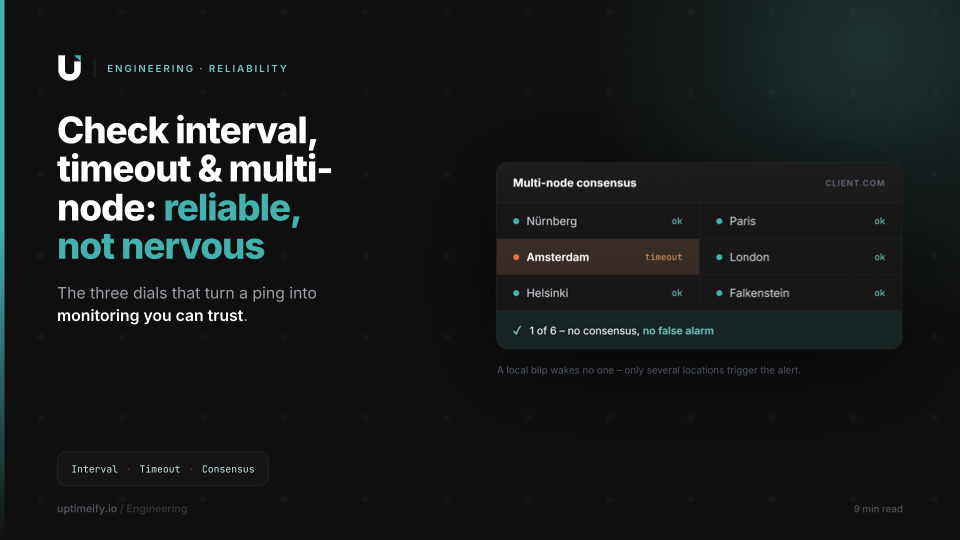
This setup has a double benefit that reaches beyond privacy. Because every outage is confirmed from several of these EU locations before an alert fires, the geographic spread also serves precision: a brief network hiccup at one node triggers no false alarm. The location diversity that stays within the EU for data-protection reasons is, technically, exactly what makes reliable alerts possible in the first place. Here, sovereignty and reliability coincide.
Staying factual: what EU monitoring does, and doesn't
Handling this topic with composure means drawing an honest line. EU monitoring simplifies the data-protection case considerably, but it doesn't replace your own legal assessment. Whether a specific processing operation is permissible in your case depends on factors no tool can decide for you: the nature of the data, the purpose, your data-processing agreements, the roles of controller and processor.
What EU polling and EU hosting do is precisely bounded: they take the third-country transfer out of the equation. That's a factual, verifiable circumstance, not a "legally compliant" seal and not a GDPR guarantee. That very sobriety is the strongest selling point: you promise your client nothing you can't prove, you show them a verifiable fact about where their data sits. In a landscape full of grand compliance claims, the factual, provable statement is the most credible one.
The location of your polling nodes is therefore not a side issue but a strategic choice. It decides whether your client's privacy question makes you sweat, or gives you an opening to prove your diligence.
Frequently asked questions
Because every monitoring check generates and processes data: which URL was checked, when, from which location, and with what response. If the checking node sits outside the EU, that processing leaves the European legal area, with all the follow-on questions about third-country transfers and US access. Keep polling and processing inside the EU and that transfer disappears, which makes your data-protection case markedly shorter.
EU hosting refers to where the platform and its database sit, where your monitoring data is stored. EU polling refers to where the checks are actually run from, the location of the checking nodes. Both need to be in the EU to reliably avoid a third-country transfer: an EU-hosted tool that polls from US data centers still moves the processing across the Atlantic.
Yes, considerably. When polling and hosting are demonstrably in the EU and no US sub-processor with access to the monitoring data is involved, the most complex chapter of any data-protection assessment disappears: the third-country transfer, along with its transfer impact assessment and standard contractual clauses. You can show your client, factually, that their monitoring data never leaves the European legal area: a short, verifiable statement instead of a long hypothetical.
The checks run exclusively from European locations: four in Germany (Nuremberg, Falkenstein, Frankfurt and Berlin) plus Logroño, Paris, Warsaw, Milan and Helsinki. Every outage is confirmed from several of these EU locations before an alert fires. The platform itself is EU-hosted too, so polling and storage stay within Europe.
It depends on the details, and that's exactly where it gets complicated. A US provider offering an EU data center is, in many setups, still subject to US law (such as the CLOUD Act), and US sub-processors are often involved in the processing. For a clean GDPR case, a provider whose polling, hosting, and processing sit entirely in the EU is the far simpler foundation. Only your own assessment can judge this in a legally binding way.

Co-Founder of Uptimeify, responsible for all of marketing. He bridges technical development and marketing strategy: from Java, PHP and Shopware plugins to steering digital growth strategies. A certified UX Manager (IHK) and digital-marketing advisor to three non-profit organizations.


Google shows sources you mark as preferred more often in its answers.
More from the blog

Monitoring Without US Sub-Processors: The Advantage in B2B and Public-Sector Pitches
Why monitoring with no US sub-processor in the data chain is a verifiable advantage in bank and public-sector pitches, with a pitch playbook for regulated MSPs.

Platform Update July 2026: 27 changes, two of them ask something of you
New probe locations, a full data export, TCP port monitoring and a second SMS carrier: every change from July in one post.
Check Interval, Timeout and Multi-Node: How Reliable Monitoring Actually Works
Check interval, timeout profiles and consensus across several EU locations: the three dials that turn a bare ping into monitoring you can trust.